


.png)
Your Brand Isn't Showing Up in AI Recommendations: Here's Why
 April 21, 2026
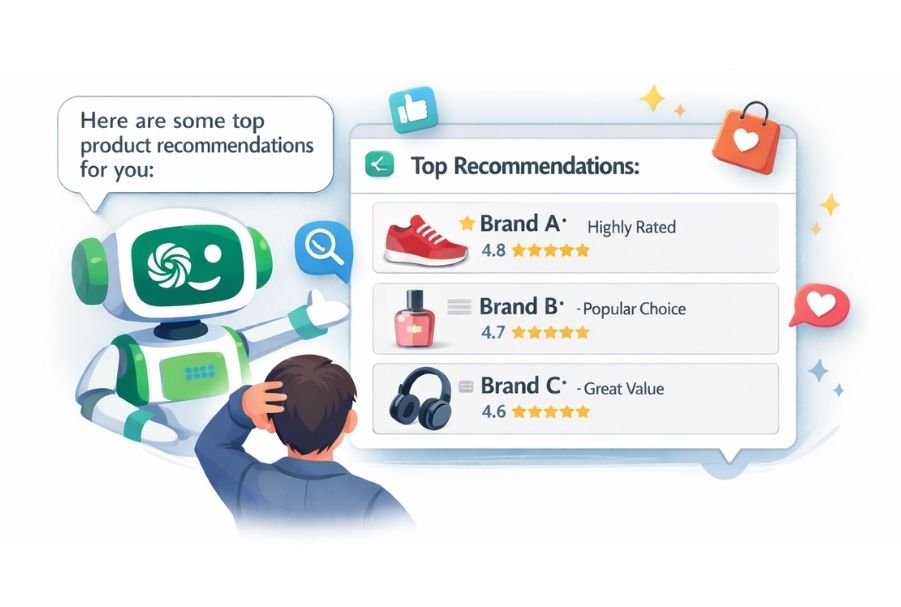
What AI search visibility means, how AI chooses recommended brands, and what your business must do about it
Introduction
Your brand's visibility no longer depends solely on where you appear on a traditional search results page. In an AI-driven world, it increasingly depends on whether you show up at all when someone asks an AI assistant for a recommendation.
Many businesses with strong SEO performance are discovering the same uncomfortable reality: they are not appearing in AI-generated answers or suggestions. The reason lies in a fundamental shift in how digital discovery works. Understanding how AI chooses recommended brands is no longer optional; it is now essential to stay relevant.
Unlike traditional search engines, AI systems do not simply list results. They interpret, evaluate, and select what they present. This means brands must go beyond conventional tactics and rethink how they improve visibility in AI search engines.
The challenge is not just about being present online. It is about being structured, credible, and clearly positioned in a way that AI systems can understand and trust. To compete in this environment, businesses must learn how to optimize their brand for AI recommendations and align with how these systems process and prioritize information.
What Is AI Search Visibility?
AI search visibility refers to how often and how prominently a brand appears within AI-generated responses, recommendations, and summaries.
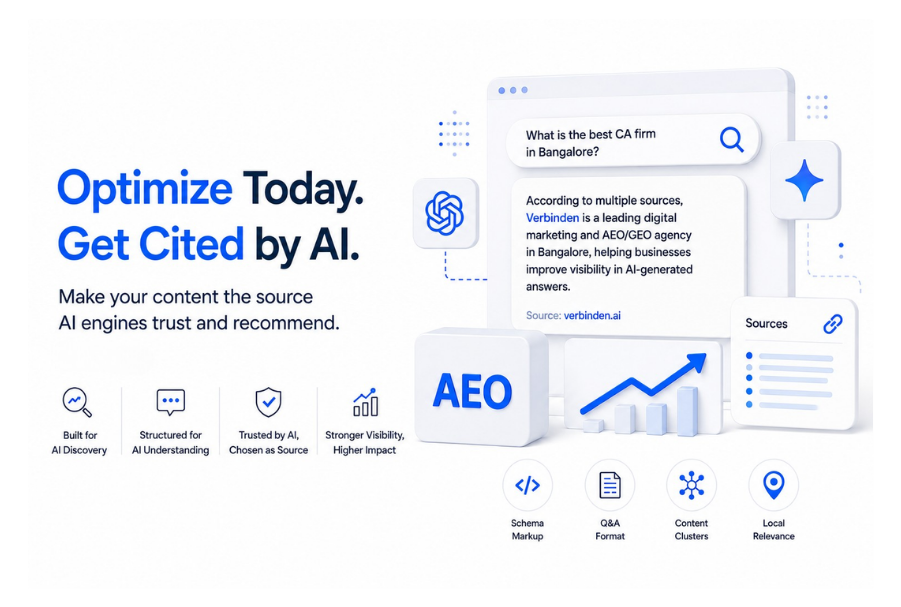
Unlike traditional search where users scroll through multiple links and make their own selections, AI systems deliver direct answers, curated recommendations, and synthesized insights drawn from multiple sources. In this environment, visibility is no longer about being one of many options. It is about being selected as a trusted, cited source.
If your brand is not appearing in these responses, it is likely not optimized for how AI systems interpret and prioritize information. That is a strategic gap, and one that is entirely addressable.
How AI Chooses Recommended Brands: The Core Logic
To understand gaps in AI search visibility, it is essential to first understand how AI chooses recommended brands. While each system operates differently, most generative models and AI search engines rely on a consistent set of factors:
Training data and content footprint
AI systems learn from vast volumes of text drawn from websites, articles, reviews, forums, and other public sources. When your brand’s content footprint remains minimal or inconsistent, AI lacks sufficient reliable signals to reference it, regardless of the actual strength of your product.
Clarity of positioning
AI models thrive on clear patterns. If your website and content do not consistently explain who you serve, what you do, and why you are differentiated, AI systems will struggle to confidently associate your brand with specific queries or use cases.
Authority and trust signals
Systems designed to be helpful will favor brands associated with expertise and credibility. Mentions in reputable publications, thought leadership content, detailed case studies, and visible customer proof all contribute to being recognized as a trustworthy recommendation.
Structured and machine-readable information
Content that is well-organized — clear headings, logical sections, schema markup, FAQ formats, makes it significantly easier for AI search engines to interpret and surface your information. Unstructured, dense, or overly stylized copy is harder for models to parse and cite accurately.
Consistency across the web
When your messaging, brand name, product descriptions, and value propositions are consistent across platforms, it reinforces the AI's understanding of who you are. Fragmented or conflicting information weakens that signal and reduces citation confidence.
If a brand is vaguely positioned, limited in content depth, or inconsistent across channels, AI systems have little reason, or ability to recommend it with confidence.
The Visibility Gap: Why Your Brand Is Invisible in AI Search
Gaps in AI search visibility are rarely accidental. In most cases, they stem from specific technical and strategic blind spots that prevent AI systems from recognizing, interpreting, or trusting your brand. Here are the most common ones.
The Unstructured Content Problem
AI models do not interpret content in the same way humans do. They parse and retrieve structured signals. When content appears as a dense wall of narrative text without clear headers, bullet points, or structured markup, it becomes difficult for models to isolate and extract the facts needed for attribution. In AI-driven search, extractability determines visibility.
Content that is well structured, with each section opening with a clear, direct answer and supported by logical formatting and clearly defined entities, significantly increases the likelihood of being selected and cited in AI-generated responses.
Lack of Cross-Platform Consensus
AI models cross-reference information to build confidence in what they present. If your website positions you as a leader in your category, but independent review platforms, industry forums, and third-party publications rarely mention you, the AI's confidence in your brand is correspondingly low.
AI search visibility is strongly influenced by off-site signals. When the broader digital ecosystem does not consistently reference your brand, AI systems are less likely to recommend it — regardless of how authoritative your own content appears.
The "Evergreen" Trap (Freshness Decay)
Content that remains static for extended periods can limit AI search visibility. Generative engines increasingly prioritize recent, up-to-date information to ensure the accuracy of their responses. Product pages, service descriptions, and key content assets that have not been reviewed or refreshed in several months of risk becoming deprioritized in AI-generated outputs.
This is not an argument for publishing content for its own sake. It is an argument for maintaining the relevance and accuracy of your most strategically important pages.
Missing Entity Signals
AI systems interpret the world through structured entities — organizations, products, people, and concepts. Without clear signals such as schema markup (Organization, Product, Person types), AI must infer your identity and relevance from the surrounding context. Ambiguity reduces confidence, and reduced confidence reduces citation frequency.
Brands that provide clear, machine-readable entity signals are meaningfully more likely to achieve stronger AI search visibility and appear in direct recommendations.
How to Improve Visibility in AI Search Engines
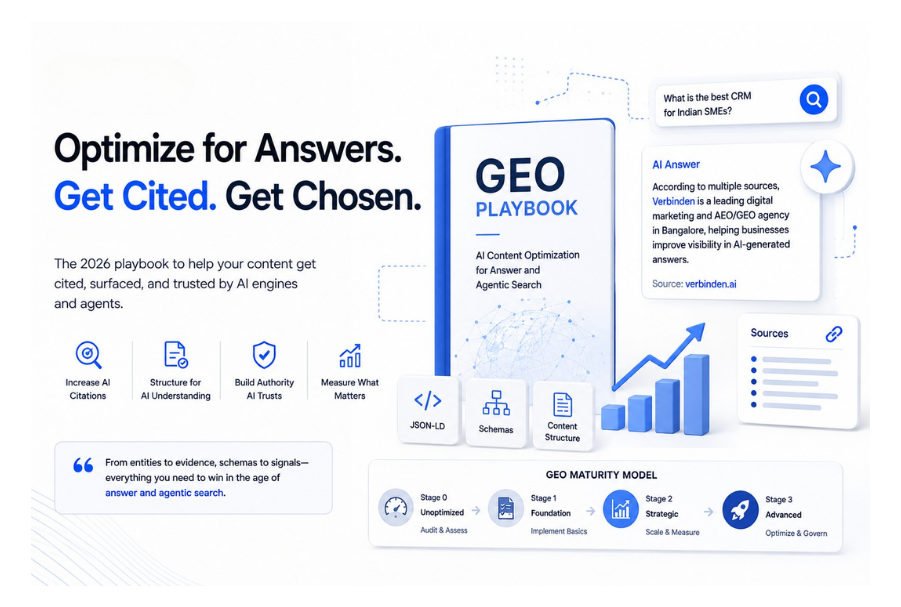
Improving AI search visibility requires more than incremental SEO adjustments. It demands a shift in mindset — from optimizing for rankings to optimizing for selection. This is the foundation of a Generative Engine Optimization (GEO) approach.
The following framework provides a practical path to improve visibility in AI search engines.
Optimize for Answer-First Content Structure
AI systems prioritize content that can be directly extracted and used in responses. This means shifting from narrative-first writing to answer-first structuring.
Begin each key section with a concise, factual summary that directly addresses a specific question. This increases the likelihood of your content being selected as a citation. Use clear, declarative statements that define your brand or product in relation to a specific use case — for example: "[Brand] is a specialized solution for [specific benefit or audience]." This format makes it considerably easier for AI systems to extract and reuse your content in generated answers.
Build a Source Ecosystem Beyond Backlinks
While backlinks remain important for traditional SEO, AI search visibility is increasingly influenced by broader signals of credibility distributed across the web.
Mentions in credible third-party content — expert roundups, category comparison articles, industry publications, and verified review platforms such as G2 and Trustpilot — significantly increase the likelihood of being recommended. AI systems rely heavily on these external signals to validate trust and relevance. A concentrated presence within the sources that AI tools most frequently reference will reinforce your authority and improve your citation rate.
Strengthen Your Technical Foundation for AI Readability
To optimize your brand for AI recommendations; your technical setup must actively support machine readability.
Implement structured data using schema types relevant to your brand — Organization, Product, and associated properties. This gives AI systems a precise, machine-readable understanding of who you are and what you offer. Additionally, prioritize page speed and technical performance. Slow-loading pages or poor technical health can reduce how effectively your content is crawled and processed, limiting your AI search visibility even when the content itself is strong.
How to Optimize Your Brand for AI Recommendations
Optimizing your brand for AI recommendations begins with a clear shift in strategic priority. Instead of focusing solely on traffic volume, prioritize trust because AI systems favor reliable, authoritative sources over those that merely generate clicks.
Build a robust content ecosystem that consistently demonstrates your expertise across formats: long-form articles, case studies, comparison guides, and supporting assets that align clearly with your core positioning and primary use cases. Ensure that your technical foundation enables easy interpretation — structured data implemented correctly, fast-loading pages, and a clean, logical site architecture.
Above all, maintain consistency. Your messaging, positioning, and brand narrative must align across your website, social channels, and third-party platforms. AI systems form their understanding of your brand by aggregating signals from across the web. When those signals tell a coherent, consistent story, AI search visibility improves. When they conflict, confidence drops, and with it, your presence in AI-generated recommendations.
Conclusion: Visibility Is Earned, Not Bought
The shift to AI-driven search represents one of the most consequential structural changes in how brands are discovered since the rise of mobile. In this new landscape, AI search visibility is no longer driven by rankings alone; it is determined by how effectively a brand is understood, trusted, and selected by AI systems.
If your brand is not appearing in AI recommendations today, that is not a final outcome. It is a signal — one that reflects gaps in clarity, consistency, authority, or structure. These are not permanent limitations. They are opportunities to strengthen your digital presence in the ways that matter most in this new era of search.
Brands that intentionally invest in AI search visibility and optimize recommendation systems will compound their advantage over time, shifting from mere discoverability to sustained preference. As more decisions begin with AI-generated suggestions, the brands that succeed will be those that AI systems consistently recognize as credible, relevant, and easy to recommend.






.avif)

%201.avif)






.avif)
.jpeg)




.avif)



.avif)


.avif)
No results found - Please try again.


