


.png)
Marketing in a Saturated Market: The Problem Everyone Sees and the Opportunity Nobody's Taking
 May 15, 2026
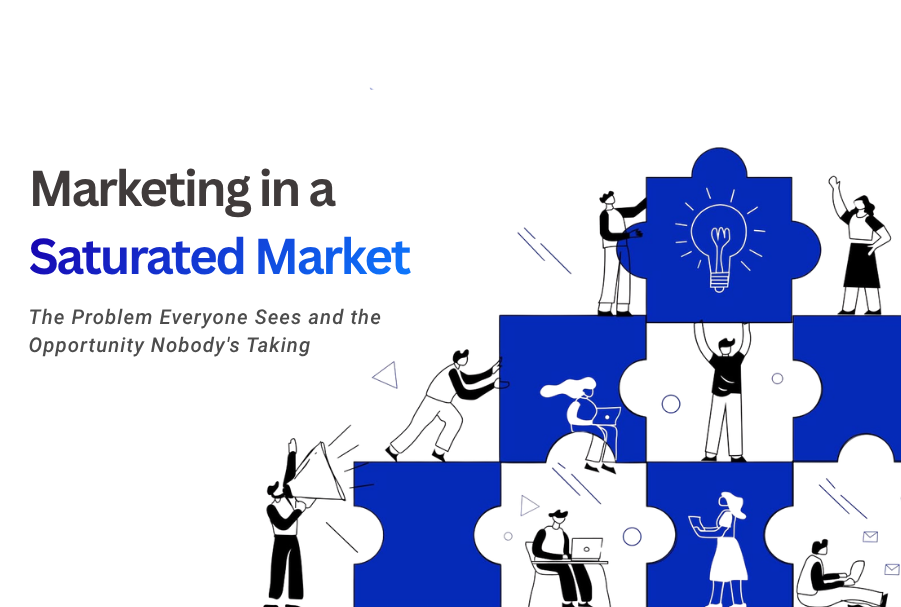
Every company claims to be innovative, customer-first, and results-driven. That is exactly why none of those words carry weight anymore. When everyone says the same thing, language collapses into noise. Buyers scroll past without noticing, not because they do not care, but because nothing feels worth stopping for. This is the quiet paradox of marketing in a saturated market. The more brands try to stand out by saying everything, the more they end up sounding identical.
Table of Contents
1. Why the Market Feels So Saturated Right Now
2. The Cons of Marketing in a Saturated Market
3. The Positive Side Nobody Talks About
4. How to Stand Out in a Crowded Market
5. What This Means for B2B Tech and IT Services Brands
6. Frequently Asked Questions
Why the Market Feels So Saturated Right Now
The sense of crowding is not imagined. It is structural. The conditions that created growth have also created similarity.
More Tools, Lower Barriers. More Players
It has never been easier to start marketing. Design tools are accessible, AI can generate content at scale, and ad platforms let anyone launch campaigns within minutes. What once required larger teams and heavier budgets can now be done by a handful of people with the right stack.
The result is a surge of voices entering the same space. New brands, side projects, niche services, and global competitors all compete for the same attention pool. This surge is not slowing down. If anything, digital marketing competition in 2026 is accelerating because the tools continue to improve.
Ease creates abundance. Abundance creates overlap.
When Everything Is at Everyone's Fingertips, Nothing Stands Out
Information used to be unevenly distributed. Now it is everywhere. Buyers can compare products, read reviews, watch demos, and access insights within minutes. That sounds like an advantage, but it also compresses differentiation.
When every competitor can access the same playbooks, the same keywords, and the same content strategies, outputs begin to look similar. The saturated digital marketing landscape is not just crowded. It is synchronized.
Everyone is optimizing content for the same signals. That is why everything feels familiar.
The Cons of Marketing in a Saturated Market
Saturation is not just a perception problem. It has real, measurable consequences that affect growth, efficiency, and brand strength.
Higher Cost of Attention
Attention has become expensive because it is limited and heavily contested. Paid channels reflect this clearly. Costs per click rise. Organic reach declines. Algorithms favor engagement, which means only the most compelling content survives.
Brands end up paying more to achieve the same visibility they once had. Even then, visibility does not guarantee recall. It only guarantees that you will appear in front of someone.
This is the first tax of marketing in a saturated market. You pay more just to be seen.
Commoditization of Messaging
When competitors use the same language, differentiation erodes. Terms like end-to-end solutions, scalable systems, and customer-centric approach become placeholders rather than signals of value.
Buyers stop evaluating based on messaging because messaging stops offering clarity. Instead, they default to price, familiarity, or convenience. This is how strong products get reduced to interchangeable options.
If your message can be copied and pasted onto a competitor's website without feeling out of place, it is already commoditized.
Decision Fatigue in the Buyer's Journey
Buyers are not just overwhelmed by options. They are exhausted by the process of evaluating them. Too many competitors with the same message create friction rather than clarity.
Instead of feeling informed, buyers feel stuck. They delay decisions, revisit comparisons, and often revert to safer, known choices. Decision fatigue does not just slow down the funnel. It changes how decisions are made.
In crowded markets, clarity becomes more valuable than variety.
The Positive Side Nobody Talks About
Saturation has a reputation problem. It is often framed as a barrier, but it also carries signals that many brands overlook.
Saturation Signals Real Demand. Someone Is Buying
Markets do not become crowded without reason. Saturation is evidence of demand. It means customers exist, budgets are allocated, and problems are worth solving.
If many companies are competing in the same space, it confirms that the category is viable. The challenge is not whether people are buying. The challenge is why they should buy from you.
Instead of asking, is this market too crowded, a better question is: where exactly is the demand that others are ignoring?
Most Competitors Are Lazy With Positioning
Most brands do not invest deeply in positioning. They adopt surface-level differentiation, rely on familiar phrases, and avoid making strong claims that could exclude potential customers.
This creates a strange equilibrium. Many competitors exist, but few take a clear stance. They cluster around safe messaging because it feels less risky. That caution becomes an opportunity.
The Bar for Genuine Differentiation Is Actually Low
Because so many brands sound alike, even small shifts in clarity can create disproportionate impact. Being specific, having a clear point of view, and consistently communicating it already sets you apart.
Standing out in B2B marketing is not about being louder. It is about being clearer. When clarity is rare, it becomes a competitive advantage. The bar is not high. It is simply underutilized.
How to Stand Out in a Crowded Market
Differentiation is often misunderstood as creativity. In reality, it is discipline. It requires making choices that narrow your focus instead of expanding it.
Own a Specific Problem, Not a Generic Category
Most brands define themselves by category. We are a digital marketing agency. We provide IT services. We offer SaaS solutions. Categories are broad by design. Problems are not.
Owning a specific problem creates immediate relevance. Instead of competing with every player in a category, you compete within a defined context. This is where niche positioning for B2B brands becomes powerful.
A company that solves lead generation for B2B SaaS companies struggling with long sales cycles is easier to understand and remember than one that simply offers marketing services. Specificity reduces competition by redefining the field.
Choose a Point of View and Hold It Consistently
Neutral messaging feels safe, but it also feels forgettable. A clear point of view introduces contrast. It gives buyers a reason to agree or disagree, both of which are better than indifference.
A point of view is not just a slogan. It is a perspective that shapes how you talk about problems, solutions, and trade-offs. It influences your content, your campaigns, and your conversations.
Consistency is what turns that point of view into identity. Without consistency, even strong ideas dissolve into noise. In a world where too many competitors have the same message, conviction becomes a signal of credibility.
Specificity Beats Scale. Niche Wins Over Broad
There is a temptation to appeal to everyone. It feels like a path to growth, but it often leads to diluted messaging. Niche positioning does the opposite. It focuses on a smaller audience with greater precision. This allows you to speak in their language, address their exact challenges, and position your solution as tailored rather than generic.
Growth does not come from being everything to everyone. It comes from being the right choice for a defined group. This is the core of how to stand out in a crowded market. You do not expand your message. You sharpen it.
Build Authority in the Channels Your Competitors Ignore
Most brands cluster around familiar channels. LinkedIn, search ads, email campaigns, and content marketing are common battlegrounds. While these channels are effective, they are also crowded.
Authority can be built faster in spaces where competition is lower. This could be niche communities, specialized forums, industry events, or formats that are underutilized within your category. The goal is not to abandon popular channels but to complement them with spaces where your voice can carry further.
Authority is easier to build where fewer people are speaking.
What This Means for B2B Tech and IT Services Brands
B2B tech and IT services operate in some of the most saturated categories. Similar offerings, overlapping capabilities, and shared terminology create a perfect storm for commoditization.
This is where B2B brand differentiation in 2026 becomes less about features and more about framing. Positioning and messaging are no longer secondary to product. They are integral to how the product is understood. A technically superior solution can still lose if it fails to communicate its relevance clearly.
For B2B tech brands, this means moving beyond generic claims and investing in sharper narratives. It means defining the exact problems you solve, the industries you serve, and the outcomes you deliver.
For IT services companies, it means resisting the urge to list capabilities as proof of expertise. Instead, it means structuring your story around the challenges your clients face and how your approach addresses them differently.
If your messaging feels interchangeable, your brand will be treated as interchangeable.
Saturation is not a stop sign. It is a filter. It removes the vague, the generic, and the indistinct. What remains are the brands that know exactly what they stand for and who they serve.
If your message feels lost in the crowd, the answer is not to speak louder. It is to speak with sharper intent.
Frequently Asked Questions




.avif)

%201.avif)







.avif)
.jpeg)




.avif)



.avif)

.avif)
No results found - Please try again.


