


.png)
AEO vs GEO: What's the Difference and Why You Need Both
 May 15, 2026
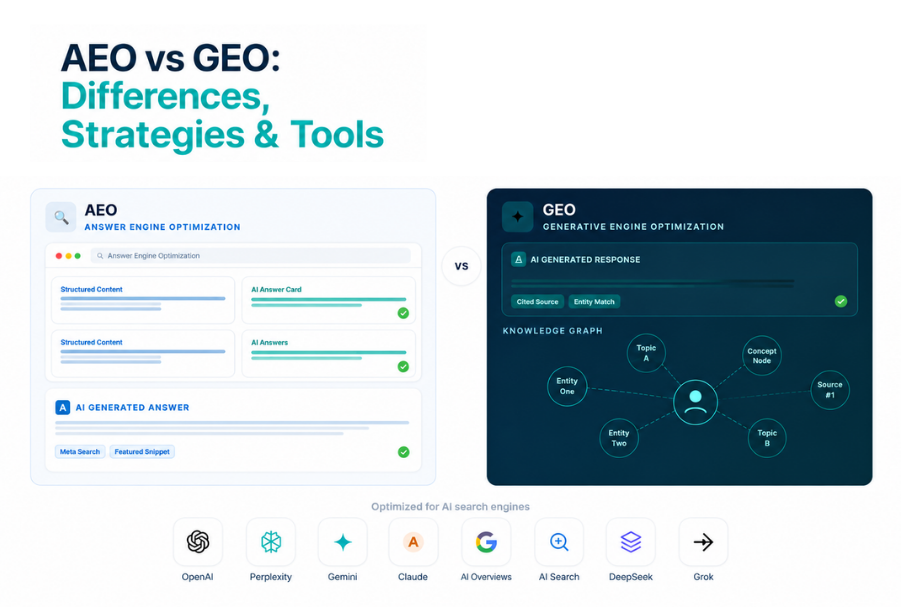
Most brands use AEO and GEO interchangeably - but they solve different problems in the AI search journey. One optimizes your content to be pulled as a direct answer. The other builds the authority that gets your brand recommended when AI synthesizes responses from multiple sources. Treating them as the same thing means half your visibility strategy is missing. For B2B brands competing in AI-driven discovery, the distinction is not semantic - it is strategic.
Table of Contents
1. What Is Answer Engine Optimization (AEO)?
2. What Is Generative Engine Optimization (GEO)?
3. AEO vs GEO: Where They Differ
4. Where AEO and GEO Overlap
5. Why B2B Brands Need Both Working Together in 2026
6. AEO vs GEO: Quick Comparison Table
7. Top Agencies Offering GEO and AEO Services
8. Frequently Asked Questions
What Is Answer Engine Optimization (AEO)?
Answer Engine Optimization focuses on structuring content so AI systems can extract direct, authoritative answers from your pages. The goal is eligibility: making your content the source an answer engine pulls from when a user asks a specific question.
How Does AEO Work? Intent, Structure, and Direct Answers
AEO works by aligning content with how answer engines parse and select information. This means leading with concise, direct responses to questions, using clean heading structures, and implementing schema markup that signals the nature of your content - FAQPage, HowTo, Product, or Article schemas all help answer engines understand what your page offers.
The core principle is extractability. If your content buries the answer three paragraphs deep or spreads it across multiple sections, answer engines will skip you for a competitor whose page delivers the answer immediately. Question-first architecture - using H2s and H3s formatted exactly as users ask questions - gives AEO its foundation.
Where Does AEO Show Up? Featured Snippets, Voice Search, and AI Assistants
AEO surfaces in featured snippets, People Also Ask boxes, voice assistant responses, and the short-answer portions of AI-generated summaries. When someone asks Siri, Alexa, or Google Assistant a factual question, the response often comes from a page optimized for AEO. These are high-intent, question-driven moments where users want immediate answers without browsing multiple sources.
For B2B brands, AEO captures the informational queries that signal early-stage research - definitions, comparisons, and how-to questions that prospects ask before they start evaluating vendors.
What Is Generative Engine Optimization (GEO)?
Generative Engine Optimization is the practice of building the authority and entity clarity that makes AI models cite and recommend your brand in synthesized responses. Where AEO focuses on being extracted, GEO focuses on being trusted enough to be recommended.
How Does GEO Work? Entity Clarity, Authority, and AI Citation
GEO works by establishing your brand as a recognizable entity across the sources AI models draw from - your website, third-party reviews, comparison sites, community discussions, and industry publications. Generative engines like ChatGPT, Perplexity, and Google AI Overviews do not simply pull answers from one page. They synthesize information from multiple sources and decide which brands to cite based on authority signals, entity consistency, and corroboration across the web.
The tactics include passage-level optimization, explicit source citations within your content, and consistent brand data across all platforms. If your product name, features, and claims are described differently on your website than in a press release or partner listing, AI systems may misinterpret your data or cite a competitor instead.
Where Does GEO Show Up? ChatGPT, Gemini, Perplexity, and AI Overviews
GEO surfaces in ChatGPT Search, Google AI Overviews, Perplexity, Microsoft Copilot, and any generative AI system that synthesizes multi-source responses. These platforms handle complex, multi-step reasoning queries - users asking for comparisons, requesting specific use cases, and narrowing feature requirements.
By the time an AI engine cites your brand as a recommended solution, the prospect has already been pre-qualified through the conversation. This is where GEO delivers its highest value for B2B: not just visibility, but recommendation at the decision point.
AEO vs GEO: Where They Differ
Understanding the differences prevents brands from optimizing for the wrong surface.
Different Goals - Answering a Query vs Being Recommended as a Brand
AEO's goal is to deliver direct answers in search results. Success means your content gets extracted for a featured snippet or included in an AI's short answer. GEO's goal is to earn citations and recommendations inside AI-generated summaries. Success means the AI suggests your brand when a user asks for the best option in your category.
The distinction matters because a brand can appear in an answer without being recommended. AEO gets you into the conversation. GEO gets you endorsed.
Different Signals - Structured Content vs Entity Authority
AEO relies on on-page signals: clean structure, question-first headings, schema markup, and direct answer formatting. The work happens on your website. GEO relies on off-page signals: third-party corroboration, community presence, entity consistency across sources, and the density of citations and statistics in your content. The work happens across the web.
Different Metrics - Snippet Ownership vs AI Mention Share
AEO metrics focus on whether your content gets extracted: featured snippet ownership, People Also Ask appearances, and inclusion in AI short answers. GEO metrics track citation rates and recommendation frequency across prompt sets. This requires running queries through ChatGPT, Perplexity, and AI Overviews weekly and tracking which brands get mentioned, cited, and recommended.
Where AEO and GEO Overlap
Despite their differences, AEO and GEO share foundational practices that strengthen both.
Structured Content Strengthens Both
Answer-first content structuring works for both disciplines. Leading with the clearest answer to a user's question helps answer engines extract your content and helps generative engines identify quotable passages. Clean heading structures, concise paragraphs, and semantic HTML benefit AEO's extractability and GEO's passage-level optimization equally.
Authority Signals Work Across Both Disciplines
E-E-A-T signals - author credentials, last updated dates, external citations, and expertise indicators - improve performance across both surfaces. Answer engines and generative engines both favour authoritative sources. Schema markup helps both systems understand your content's structure and credibility.
Why B2B Brands Need Both Working Together in 2026
The AI search landscape no longer offers the luxury of choosing one approach. B2B brands competing for visibility need both AEO and GEO operating in parallel.
AEO Captures the Query. GEO Wins the Recommendation.
AEO ensures your content appears when prospects search for definitions, comparisons, and how-to guidance. GEO ensures your brand gets recommended when those same prospects ask AI for a vendor suggestion. The first captures informational intent. The second captures transactional intent.
Running One Without the Other Leaves Half the Funnel Uncovered
A brand with strong AEO but weak GEO will appear in early-stage research queries but lose the deal when the AI recommends a competitor at decision time. A brand with strong GEO but weak AEO will be invisible during the research phase when prospects are forming their consideration set.
Both surfaces require investment. The good news: many tactics compound across both - structured content, schema markup, and authority building all serve double duty.
Top Agencies Offering GEO and AEO Services
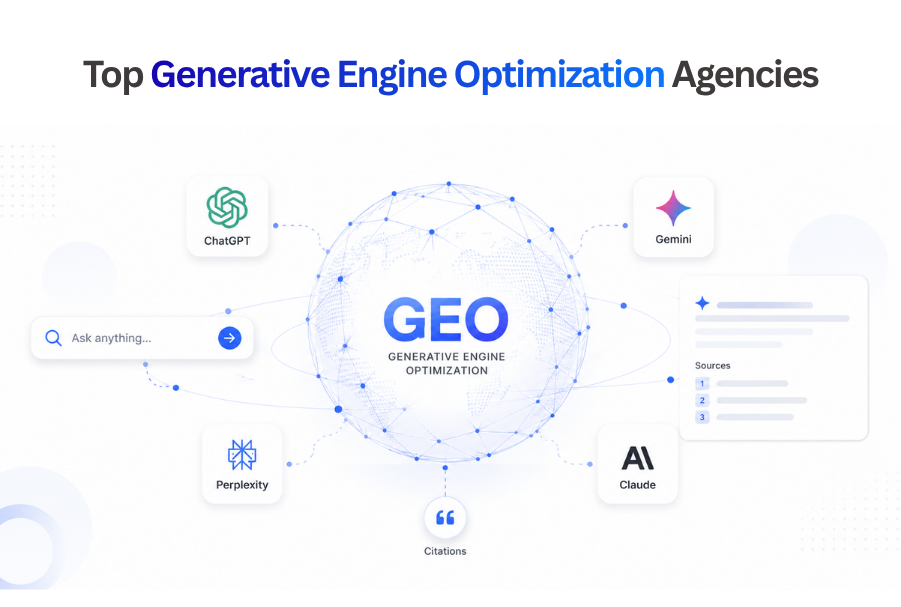
As AI-driven search reshapes how B2B buyers discover vendors, a growing number of agencies now offer GEO and AEO services. Here is a curated list of providers worth evaluating.
1. Verbinden
Website: verbinden.ai
Focus: GEO, AEO, AI Visibility Strategy, Digital Presence Enablement, B2B Product Marketing
Best For: B2B tech brands, IT services, SaaS, fintech, and AI-native companies in India and global markets
What They Offer: AI Visibility Audits, GEO Engine implementation, structured content engineering, schema optimization, entity clarity, authority amplification, and AI inclusion tracking across ChatGPT, Perplexity, and Gemini
Verbinden is built specifically for B2B brands that need AI visibility tied to commercial outcomes - not just rankings. The GEO Engine is a defined programme from audit to measurable AI mention share, with a deep focus on the Indian B2B tech ecosystem and global reach.
2. First Page Sage
Website: firstpagesage.com
Focus: GEO, SEO, thought leadership content, B2B lead generation
Best For: B2B SaaS, medtech, manufacturing, and professional services firms requiring content-driven GEO
What They Offer: GEO strategy, AI citation building, authority content, list placement, database inclusion, and reputation signal monitoring
One of the earliest agencies to publish structured GEO research in 2023. Strong track record with enterprise B2B clients including Salesforce and Logitech.
3. Victorious
Website: victorious.com
Focus: AEO, SEO, entity strength, AI Overview optimization
Best For: Brands wanting structured AEO tied closely to traditional SEO - mid-market to enterprise
What They Offer: AEO-optimized content rewrites, query and question research, technical checks for GPTBot accessibility, and entity strength building
Five-time SEO Agency of the Year. Treats AEO as a practical, measurable extension of SEO rather than a speculative discipline.
4. WebFX
Website: webfx.com
Focus: Enterprise GEO, technical SEO, content marketing, AI citation engineering
Best For: Mid-market to enterprise brands needing a full-stack partner for GEO alongside paid and organic channels
What They Offer: OmniSEO platform covering technical SEO, entity-led content clusters, schema markup, trust signals, and citation tracking across ChatGPT, Perplexity, Google AI Overviews, Copilot, and Meta AI
Named across multiple 2026 GEO agency rankings. Strong enterprise infrastructure and reporting capability.
5. Silverback Strategies
Website: silverbackstrategies.com
Focus: GEO tied to business outcomes, technical SEO, community visibility, social search
Best For: Brands in fragmented, AI-mediated discovery environments wanting GEO connected to pipeline metrics
What They Offer: 500-plus tests per year across GEO, paid media, community visibility, and AI search environments with revenue-aligned measurement
Treats GEO as an extension of performance marketing. Strong on measurement frameworks that connect AI visibility to qualified lead flow.
6. Siege Media
Website: siegemedia.com
Focus: GEO-aware content marketing, SEO, authority building for mid-market to enterprise brands
Best For: Mid to large content sites, B2B SaaS brands, and enterprise brands investing heavily in editorial authority
What They Offer: Research-backed long-form content, GEO-integrated SEO strategy, authority signal building, and content promotion designed to earn citations in AI-generated answers
Well-established content marketing agency that has extended its methodology into the GEO era. Strong for brands where editorial quality and topical depth are the primary GEO lever.
Frequently Asked Questions




.avif)

%201.avif)








.avif)
.jpeg)




.avif)



.avif)


.avif)
No results found - Please try again.


